
Festo electric automation for precision motion
Precision Festo motion, ready to spec.
Coast Pneumatics helps you spec, source, and support Festo motion control systems for positioning, torque, speed, and washdown-ready actuation as an official Festo distributor.
Built for OEMs, maintenance teams, and automation engineers
Use this page to narrow the right drive, motor, or actuator family before requesting
sizing support.
EtherCAT
PROFINET
EtherNet/IP
Modbus
IO-Link
Interactive product explorer
Find the right Festo motion component faster.
Select a product family to see where it fits, which specifications matter, and how Coast Pneumatics can help with sizing and availability.
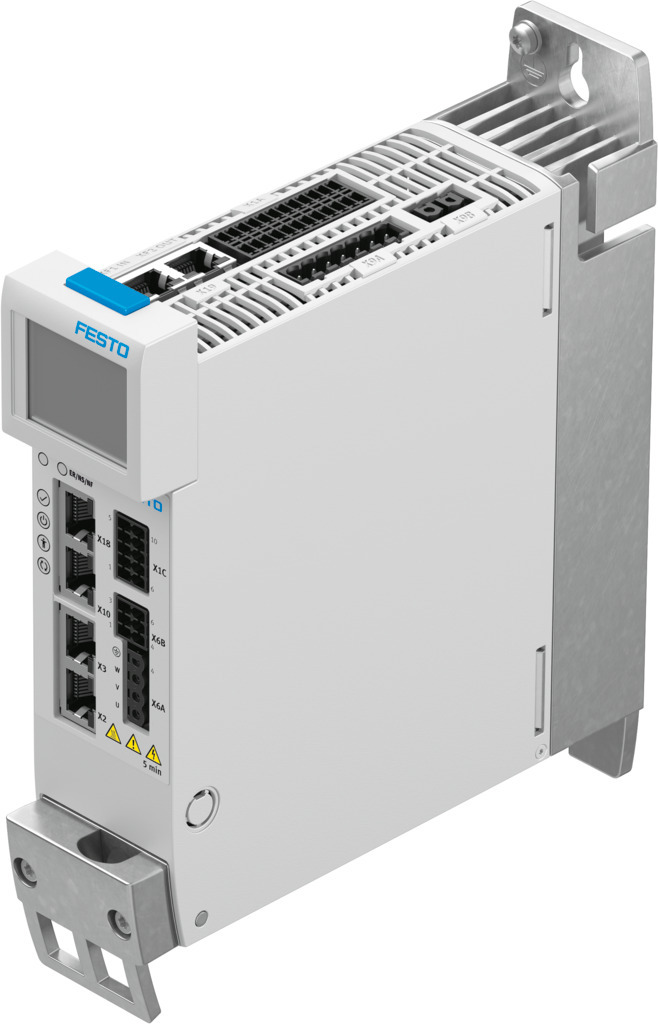
Multi-protocol servo drive
CMMT-AS & CMMT-ST servo drives
Compact Festo drive controllers for point-to-point and interpolating motion, designed to bridge the mechanical axis and the control system.
Shop this product
Best fit
Machine builders who need Ethernet-based integration, controlled torque and speed, and a scalable path from low-voltage stepper axes to high-power servo axes.
Typical applications
Application matchmaker
What are you moving?
Festo motors and servo drives are commonly used in packaging, robotics, medical technology, metal fabrication, printing, conveyors, and assembly systems.
Recommended starting point
CMMT-AS drive + EMMT-AS servo motor
Use this pairing when the axis needs dynamic response, repeatability, and precise position or torque control through the production cycle.
Servo vs. stepper
Choose the right motion technology for your machine axis.
Both technologies move a load from point A to point B. The right choice depends on speed requirements, load variation, and how much closed-loop feedback your application actually needs.
You need feedback, speed, and dynamic precision.
Servo systems use a closed-loop encoder signal to continuously correct motion, holding position and torque under changing load conditions.
- Cycle times are short and load changes during motion
- Precise torque control or speed regulation is required
- The axis must recover from disturbances without losing position
- High-speed motion with tight repeatability is critical
Speed
Precision
Cost
Simplicity
You need simple, economical positioning.
Stepper motors move in discrete, open-loop steps — a cost-effective choice for axes where high-speed dynamic correction is not required.
- Motion is light-load and does not vary significantly
- Format changes, stops, or guide adjustments at moderate speed
- Budget is a primary constraint for the axis design
- Simple indexing with open-loop control is acceptable
Speed
Precision
Cost
Simplicity
Not sure which fits your axis? Ask a Coast Pneumatics engineer for a quick recommendation.
Real-Life Uses
How these products get used on real machines.
Each Festo product family plays a different role on the machine. Here is one common, practical use case for each unit so customers can picture where it fits.
Packaging & Assembly
Packaging machine axis control
Use the drive to control a sealing jaw, cutting station, or indexing conveyor where the motor needs precise speed, position, and timing from the PLC.
Synchronized multi-axis timing from a single control system
Robotics & Pick-and-Place
Pick-and-place or robotic transfer
Use the servo motor on a robotic arm, gantry, or transfer axis where smooth motion, dynamic response, and repeatable positioning are critical to cycle time.
Consistent cycle times even under variable loads
Conveyor & Indexing
Format change and indexing movement
Use the stepper motor for guide rail adjustment, stop positioning, or simple conveyor indexing where the motion must be consistent but not highly dynamic.
Economical open-loop control for light-load axes
Food & Beverage
Washdown product stop or lift station
Use the actuator package in food or beverage equipment for reject gates, lift stations, and controlled linear motion in high-pressure washdown areas.
IP69K protection rated for daily high-pressure washdown
How It Works
What each unit actually does in the motion system.
These products are usually combined into one motion package. Each unit has a specific job inside the signal chain from control system to physical movement.
Control System
PLC / IPC
CMMT Drive
Motion controller
EMMT Motor
Rotary output
EPRF Actuator
Linear travel
Step 1
CMMT-AS / CMMT-ST servo drives
The drive is the motion controller for the axis.
The drive receives commands from the control system, converts incoming power, and sends controlled electrical output to the motor so the axis moves at the commanded speed, torque, and position.
Step 2
EMMT-AS servo motor
The servo motor turns electrical control into responsive rotary motion.
The servo motor uses encoder feedback to continuously correct motion, helping the machine hold position, accelerate quickly, and stay accurate under changing loads.
Alt. Step 2
EMMT-ST stepper motor
The stepper motor moves in precise step increments.
The stepper motor advances in controlled open-loop steps — useful for straightforward positioning tasks where repeatable movement matters more than high-speed correction.
Step 3
EMMH-AS + EPRF-BS actuator package
The actuator converts rotary motor motion into controlled linear travel.
The motor drives the actuator mechanism to create precise push, pull, lift, or stop motion. The IP-rated design protects the unit in harsh or sanitary production environments.
Quote Support
Get the valve assembly matched to the process.
Share the media, pipe size, connection type, pressure, temperature, material needs, actuation preference, and fail position.
888-918-8432
sales@coastpneumatics.com
Process valve support for machine builders and plant maintenance
Ready To Request A Valve?
Go to Contact Us page
Use the Coast Pneumatics contact form.
Send your process details through the main Coast Pneumatics form and the sales team will help match the valve body, actuator, sensing, fittings, and support package.
Contact Coast Pneumatics